Three ways of turning water into ice
Every home ice maker does the same basic job, yet the three common designs go about it so differently that they barely count as relatives. The difference is not only the shape that lands in the bin. It decides whether the unit needs a drain, how much water it throws away, how often it wants cleaning and which parts eventually give out.
Crescent cubes from a molded tray
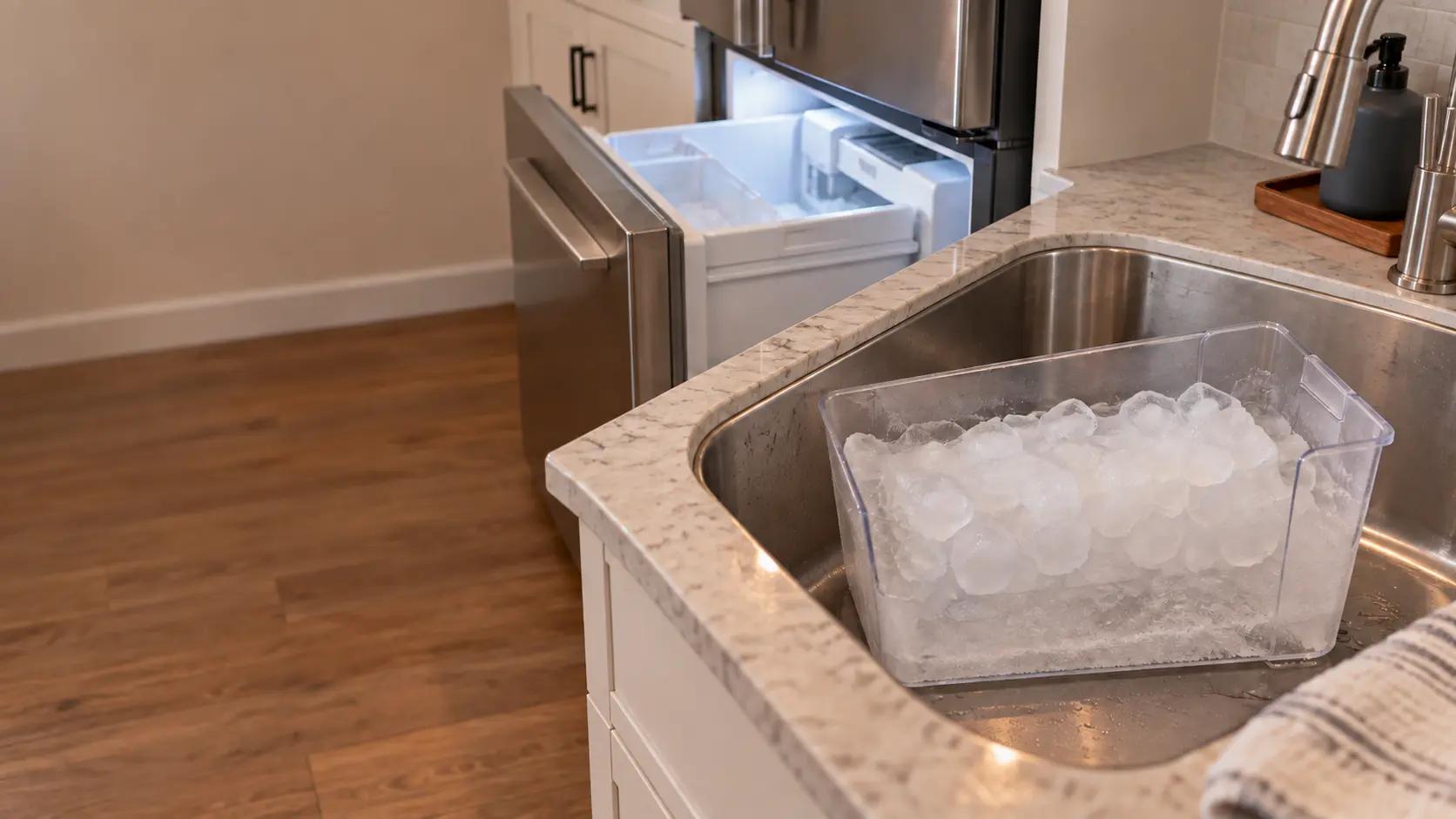
The ice maker in a freezer compartment, or the one tucked behind a door dispenser, fills a small mold with water, waits for it to freeze solid, then warms the mold briefly and sweeps or twists the cubes out. The result is the familiar half-moon shape. Because the whole charge of water freezes from the outside in, dissolved minerals and air end up locked in the last part to freeze, which is why the center of those cubes looks milky.
Clear cubes built up in layers
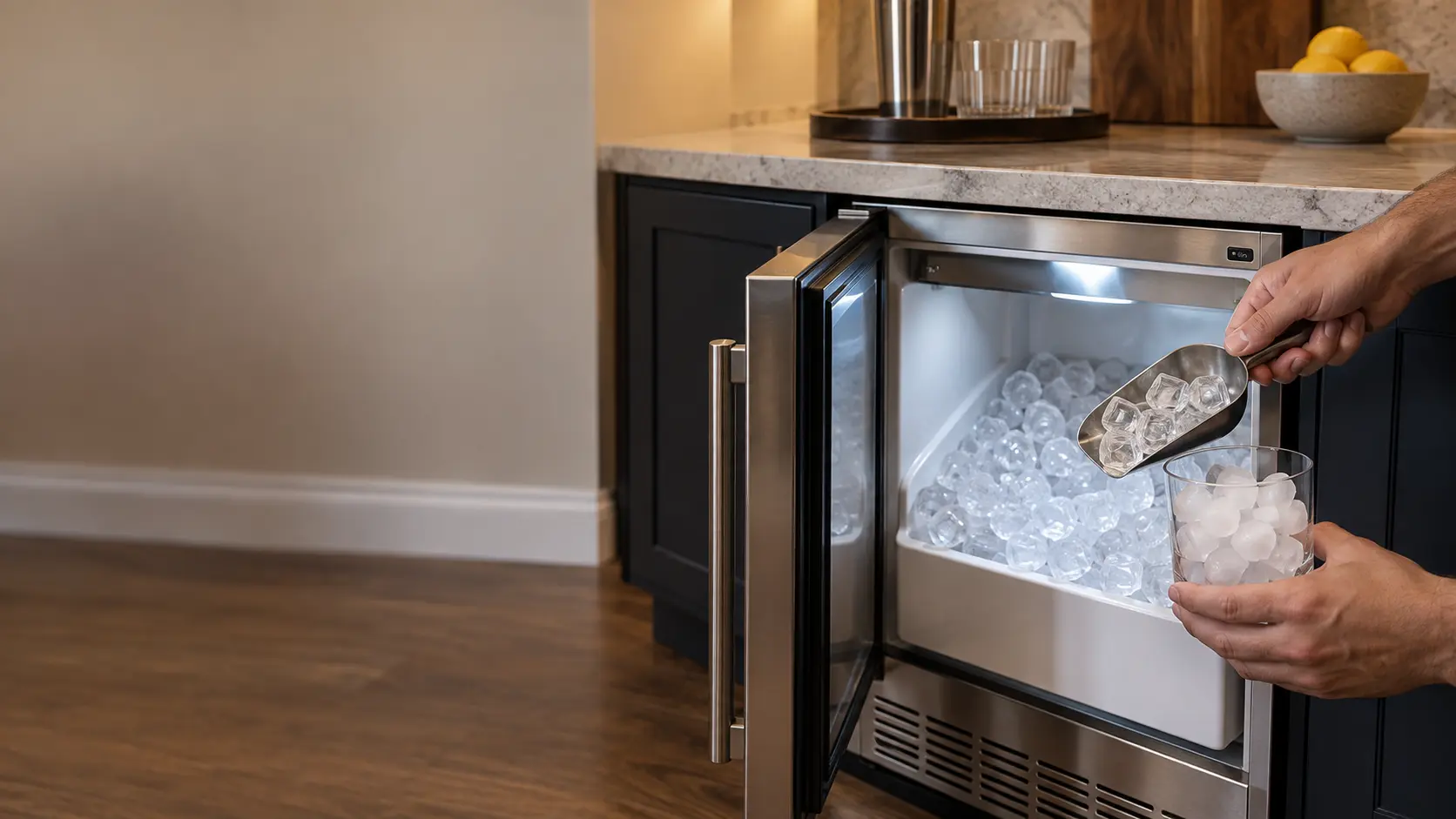
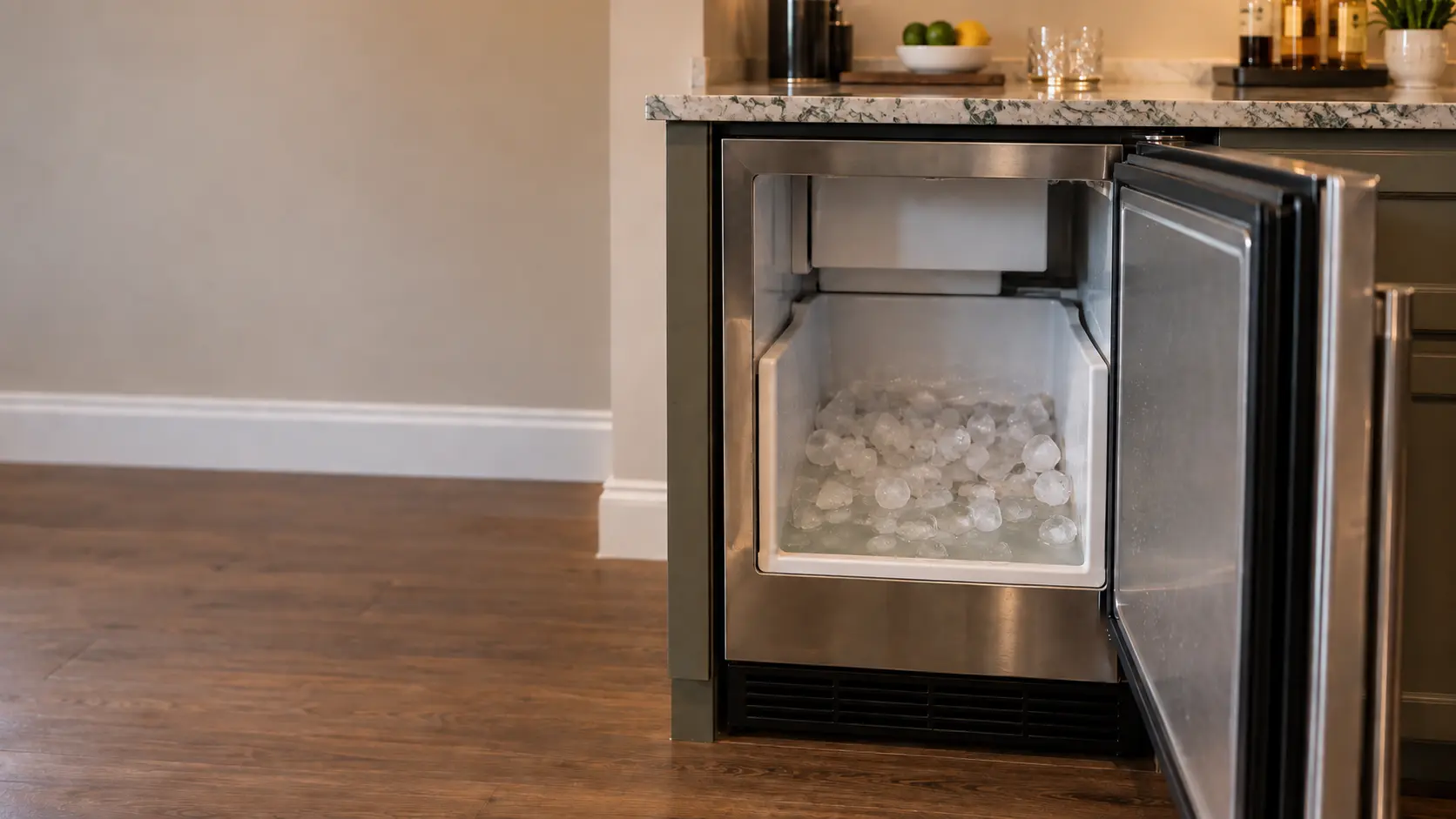
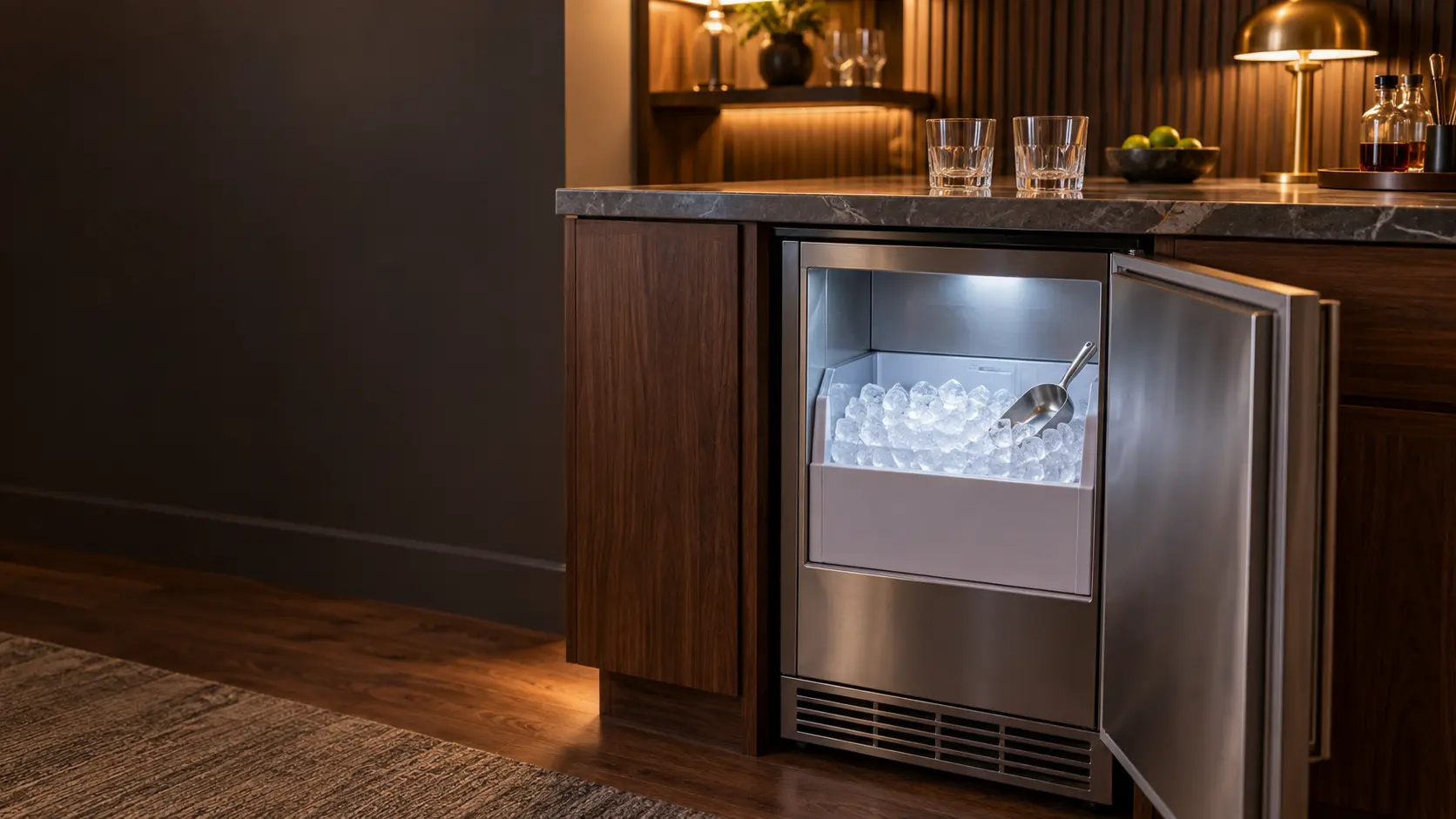
Undercounter clear-ice units run water over a chilled plate so that ice grows one thin layer at a time. Water that has not frozen carries the minerals and air away, and it leaves through the drain. U-Line describes its units in exactly those terms, and Sub-Zero explains that its undercounter bins are insulated but not refrigerated, so the cubes melt very slowly and stay wet, separate and glassy.
Nugget ice pressed from flakes
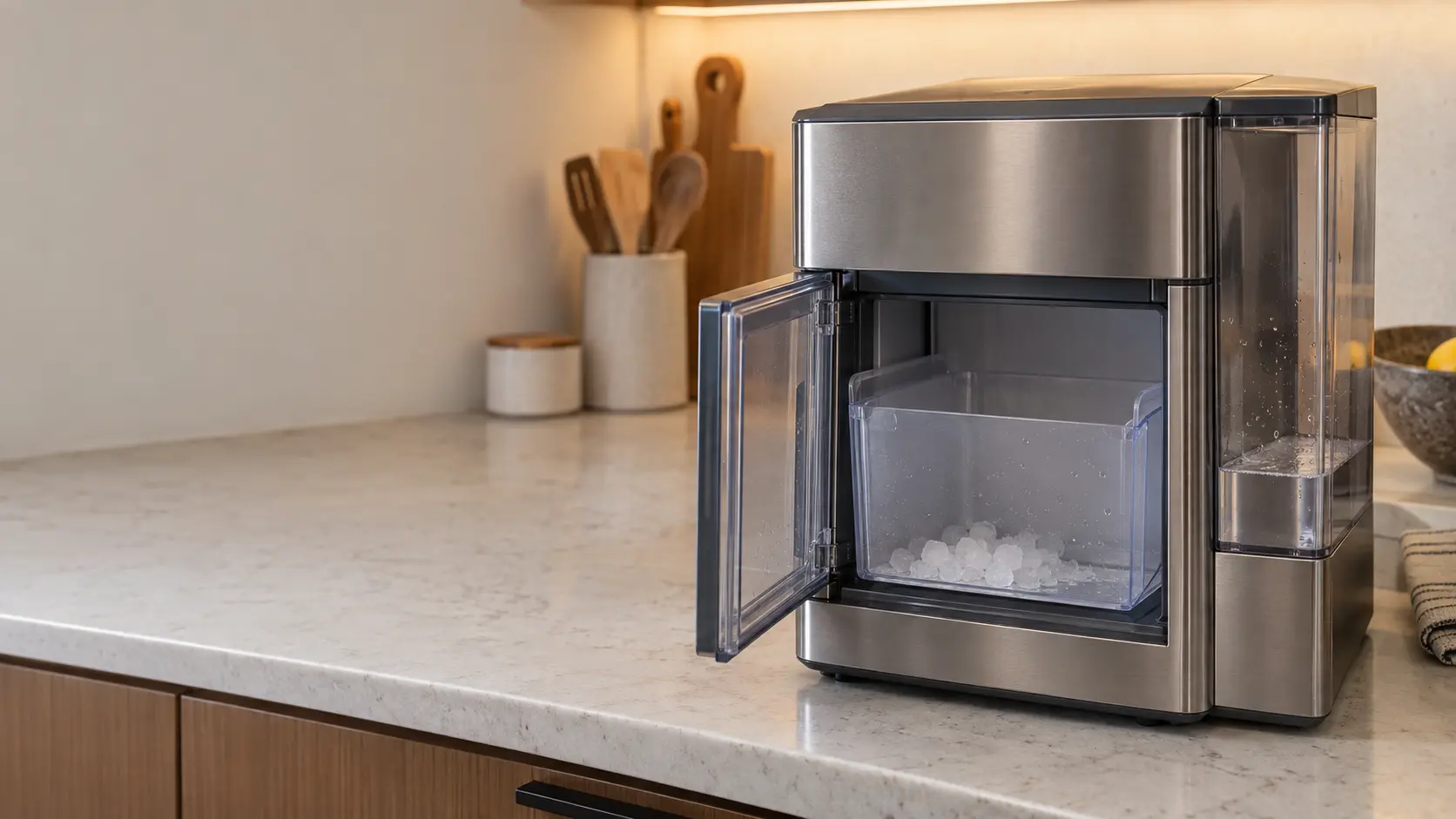
A nugget unit freezes a film of water on the inside wall of a cold cylinder, and a slowly turning auger shaves it off as flakes. The flakes are pushed upward and squeezed through a narrow opening, which packs them into short, soft cylinders. U-Line's nugget units work this way, and the same idea runs on a much smaller scale inside countertop models such as the GE Profile Opal.
Source: Scotsman Home Ice — A clear difference — In a tray-style ice maker water with its impurities freezes into the cube; clear cubes form while impurities are flushed to the drain, and are slower to melt; U-Line — Undercounter ice makers: clear and nugget technology — Clear ice is frozen in layers with impurities discarded; nugget ice is shaved by an auger and compacted into cylinders; the bin acts as a cooler, not a freezer; Sub-Zero — Sub-Zero ice types — Undercounter models make clear, wet cubes because the bin is insulated but not refrigerated, so the ice melts continuously
How each kind behaves in a drink
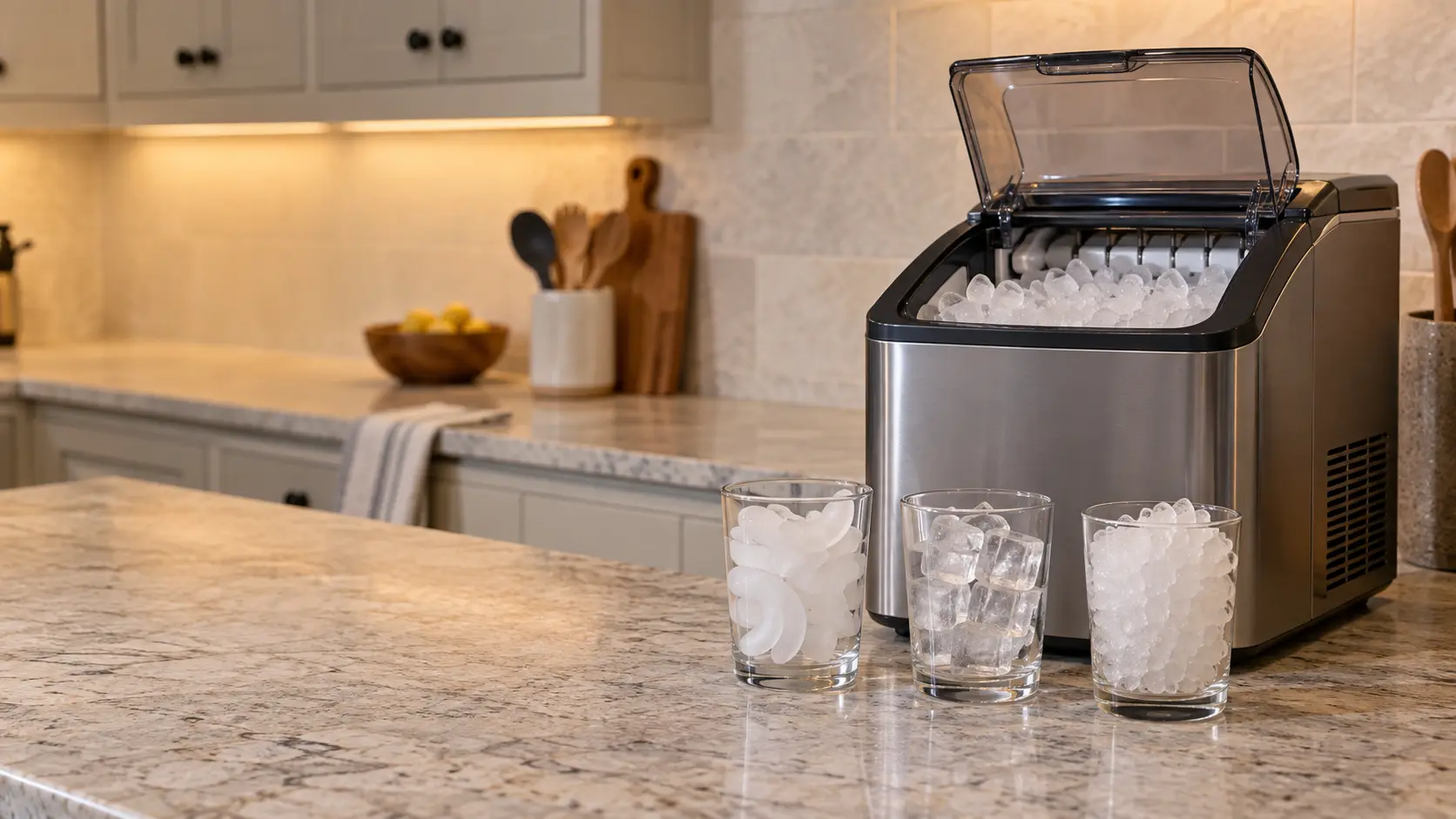
Set nugget ice vs clear ice side by side in two glasses and the difference shows within minutes. Clear cubes are dense and hold very little trapped air, so they melt slowly and water a drink down less over the time it takes to finish it. That is why people who serve spirits over ice, or who entertain around a home bar, tend to ask for them. They also simply look better when guests are watching the pour.
Nugget ice is the opposite in nearly every way. It is soft enough to chew, it soaks up a little of the drink, and it packs tightly into a cup, so a tall soda stays cold to the last sip. It also melts faster than a solid cube, which suits iced tea and blended drinks better than a slow bourbon.
Crescent cubes sit between the two. They chill a glass well and cost nothing extra, but they clump more readily when the freezer warms slightly between cycles, and they carry more of the water's own taste, since the minerals are frozen into them instead of being rinsed away.
- Choose clear cubes for spirits, cocktails and a bar that sees company.
- Choose nugget ice for chewers, soft drinks, smoothies and children's cups.
- Stay with crescent cubes when the ice mostly goes into water glasses and picnic coolers.
Source: Scotsman Home Ice — A clear difference — In a tray-style ice maker water with its impurities freezes into the cube; clear cubes form while impurities are flushed to the drain, and are slower to melt
What each design asks from the house
A door or freezer ice maker needs only the cold water line that already feeds the cabinet, and because it never discards water it needs no drain. A clear-ice undercounter unit is different: every cycle rinses off the minerals it refused, so it must be plumbed to a drain, either by gravity to a point lower than its outlet or through a small pump that lifts the water to a sink tailpiece or standpipe.
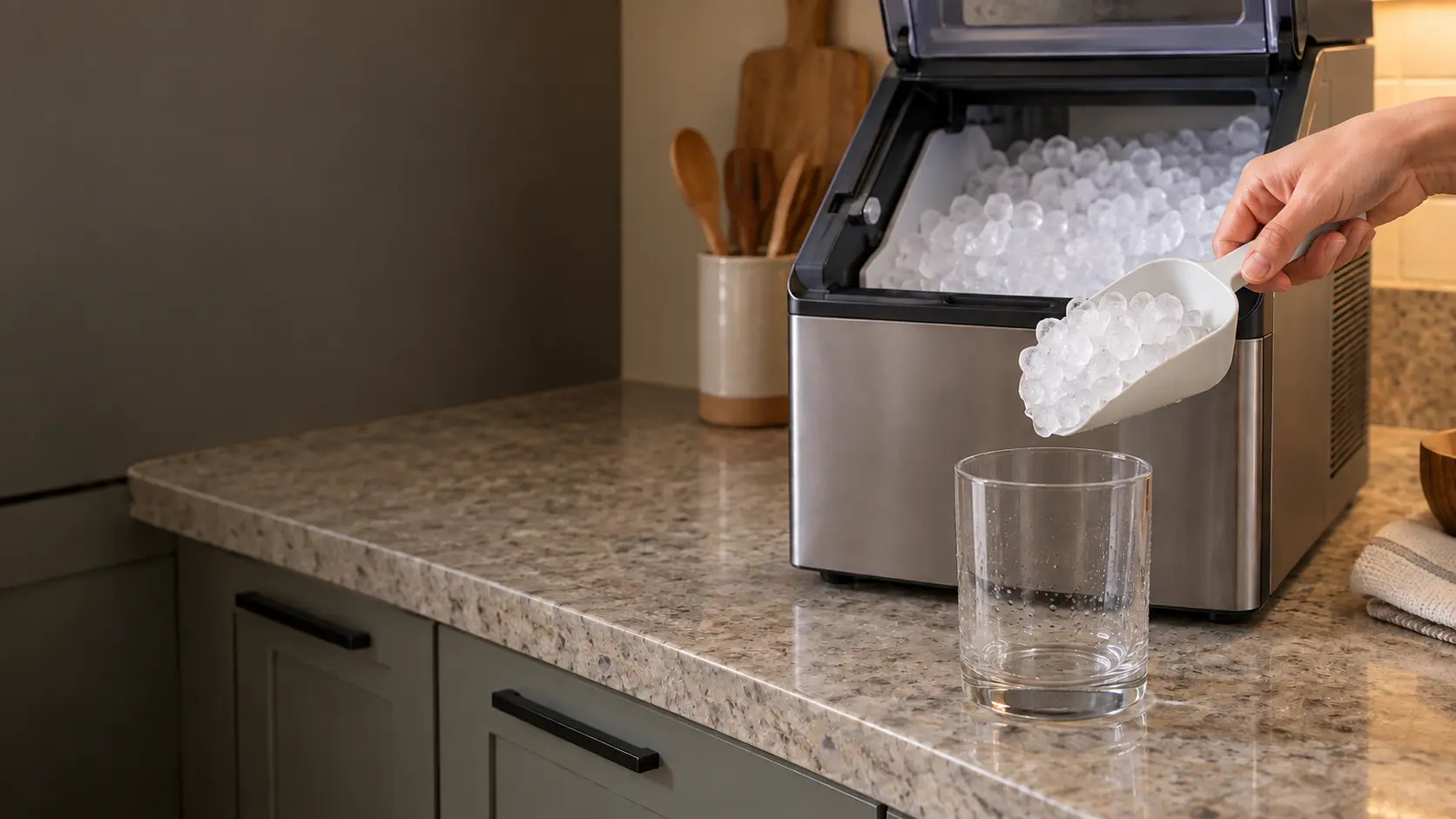
Countertop nugget models skip the plumbing entirely. You pour drinking water into a reservoir and plug the unit in. Whatever minerals that water carries stay inside the small tank until it is emptied, which is one reason GE asks Opal owners to descale every two to three weeks, depending on how hard the water is and how much ice they make.
- Freezer or door ice maker: a cold water line and the outlet already behind the cabinet; no drain.
- Undercounter clear ice: a water line, a drain below the outlet or a drain pump, and a cabinet-sized opening.
- Undercounter nugget ice: a water line and, in most installations, a drain route.
- Countertop nugget: counter space, an outlet and a jug of drinking water.
Source: GE Appliances — Opal ice maker cleaning and descaling — Descale every 2–3 weeks depending on water hardness; with distilled water only, mineral removal is most likely not needed
Upkeep and the parts that wear
Crescent ice makers ask for the least. A filter change at the interval the maker prints and an occasional wash of the bin cover most of it, and when the ice-making module finally gives out it is usually replaced as a single unit.
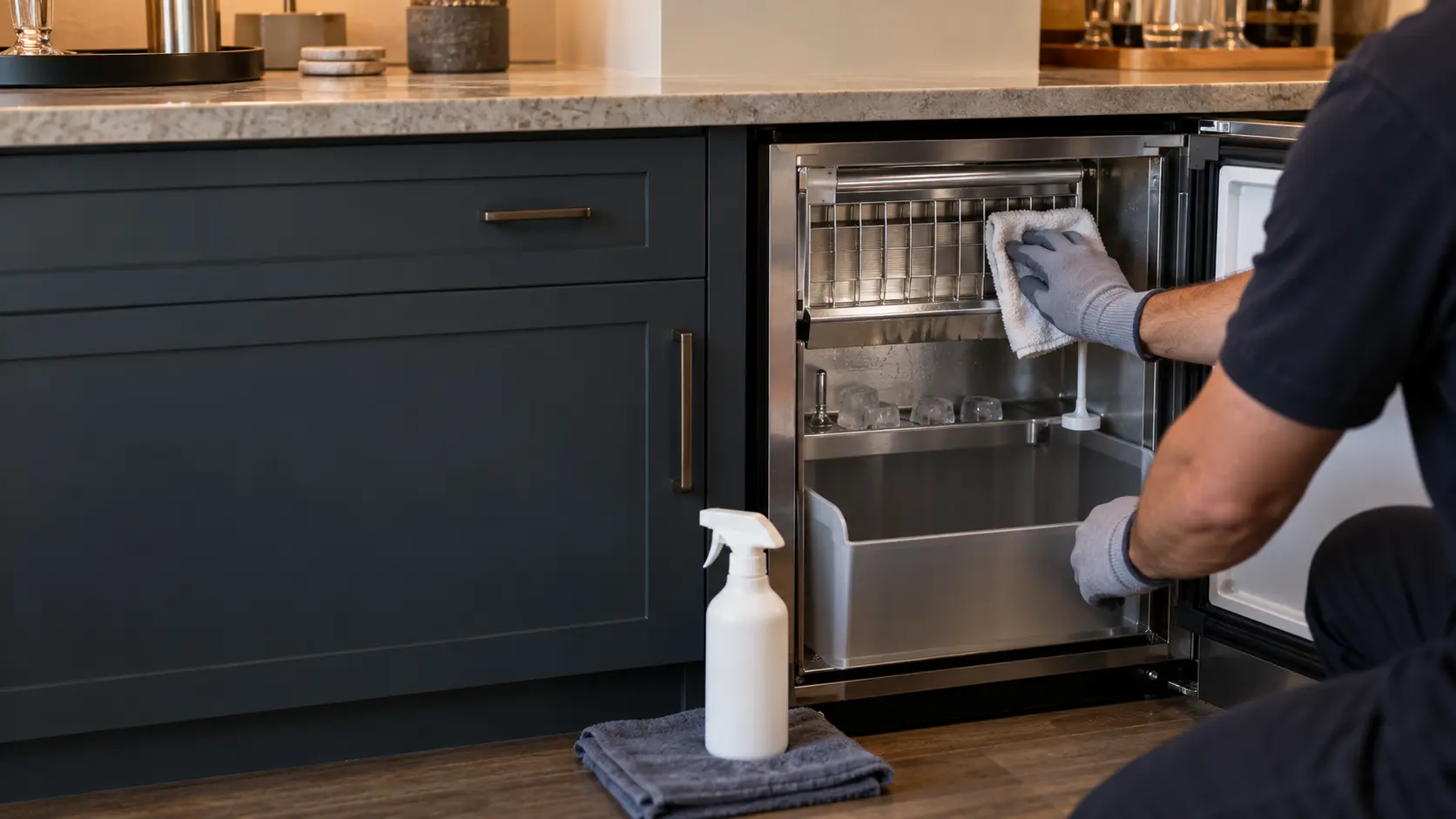
Clear-ice units need a descaling cycle with the maker's own cleaner; U-Line tells owners to run it when the clean alert appears, or every three months otherwise, and more often on hard water. Nugget units add an auger, a gear motor and bearings to the list of wearing parts, and scale on the freezing cylinder makes that auger work harder with every turn.
Where hard water tips the decision
If your utility's water quality report or a home test shows hard water, count it into the choice. The USGS classes water from 121 to 180 milligrams per liter, measured as calcium carbonate, as hard, and anything above 180 as very hard. A clear-ice unit sheds part of that load down its drain every cycle, while a nugget cylinder and a countertop reservoir hold on to it and ask for descaling more often.
Source: U-Line — Clear ice maker user guide and service manual (U-CLR1215B) — Run the cleaning cycle when the clean alert shows, otherwise every three months, more often depending on water conditions; USGS Water Science School — Hardness of water — 121–180 mg/L as calcium carbonate is classified as hard and more than 180 mg/L as very hard
Matching the ice to the room
Start with the room rather than the ice. A kitchen with a French door or side-by-side model and a door dispenser already has an ice source; a second one earns its place only if the household regularly runs the first one empty or wants a different kind of ice. A home bar, a butler's pantry or a lower-level family room is where an undercounter clear or nugget unit makes sense, provided a drain can be reached or a pump fitted.
Renters, and anyone who cannot open a cabinet to run a water line, are better served by a countertop nugget model. It asks for nothing but counter space and an outlet. The trade-off is a small basket and regular refilling: GE lists its Opal at 24 pounds of ice a day with about 48 ounces held at once, which suits a household's drinks but not a party of twenty.
Source: GE Appliances — Nugget ice and undercounter ice makers — The countertop Opal produces 24 pounds of ice a day and holds up to 48 ounces at a time