What scale does inside the cabinet
Hard water carries dissolved calcium and magnesium, and the USGS explains that those minerals leave solid calcium carbonate deposits that shorten equipment life and clog pipes. An ice maker concentrates them. A clear-ice unit rinses the rejected minerals off its freezing plate every cycle, and a little stays behind each time on the plate, in the water trough, in the distribution tube and in the pump.
The plate is where it shows first. Cubes release late or stick, harvests stretch out and the bin refills slowly. On a nugget unit the deposit forms on the freezing cylinder, and the auger has to shave through it, which is heard as a harsher grind and seen as fewer nuggets.
Reading your own water
Community water systems publish a yearly drinking water quality report, and some include hardness. The USGS classes 61 to 120 milligrams per liter as moderately hard, 121 to 180 as hard and anything above 180 as very hard. If your number sits in the upper two bands, expect to clean more often than the default and consider treatment on the supply line.
Signs a clean cycle is overdue
The unit usually tells you before the ice does, but not always. Look for these even when no alert is showing.
- A white or gray crust on the evaporator or along the water trough.
- Cubes that come out thin, cloudy or fused together in sheets.
- Long gaps between harvests while the bin is still half empty.
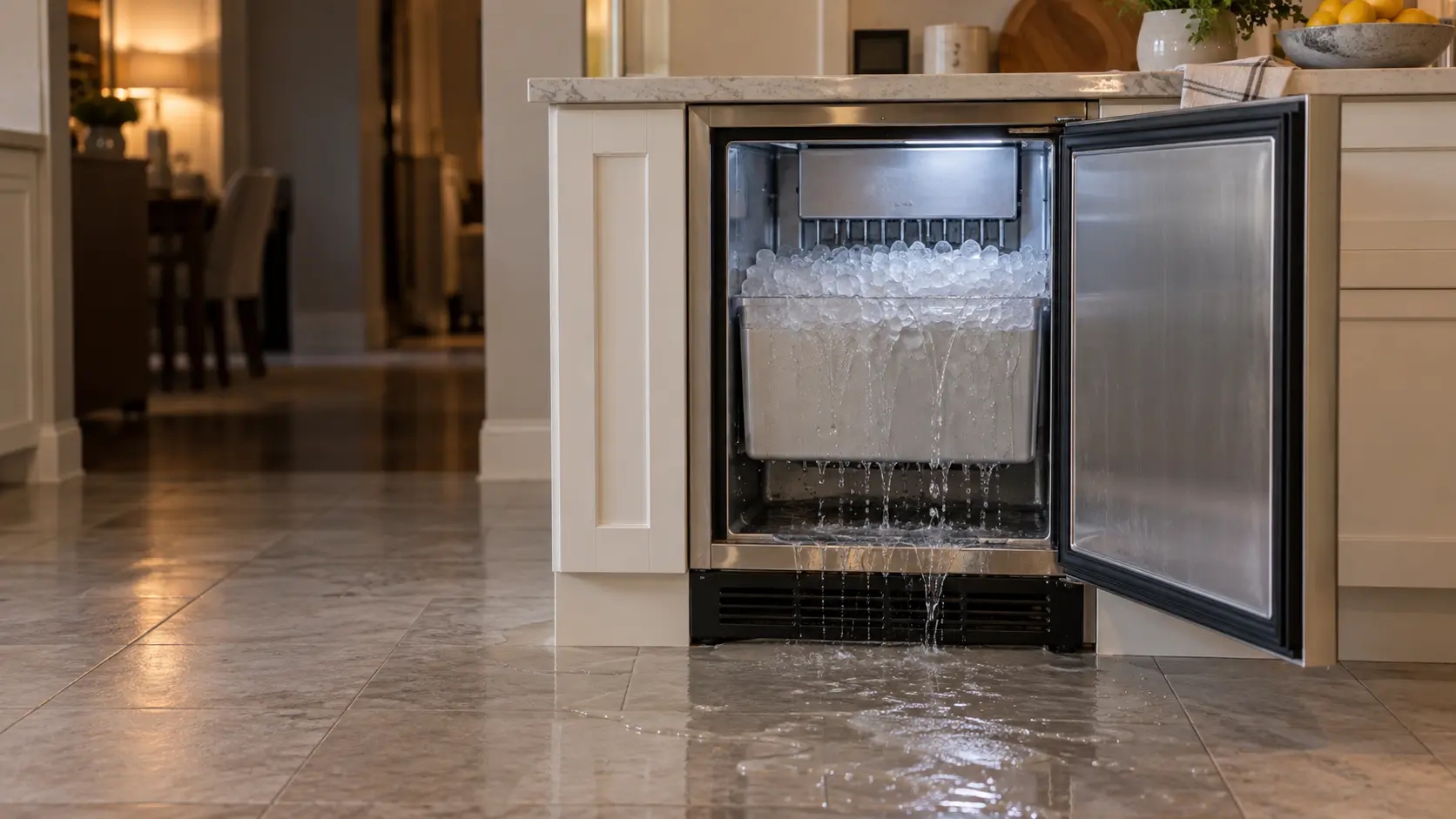
- Water splashing over the trough or into the bin during the freeze.
Source: USGS Water Science School — Hardness of water — Hard water leaves calcium carbonate scale that can reduce equipment life and clog pipes; 61–120 mg/L is moderately hard, 121–180 hard, above 180 very hard; EPA — Consumer Confidence Reports (annual drinking water quality reports) — Community water systems provide customers with an annual drinking water quality report
Running the clean cycle on a clear-ice unit
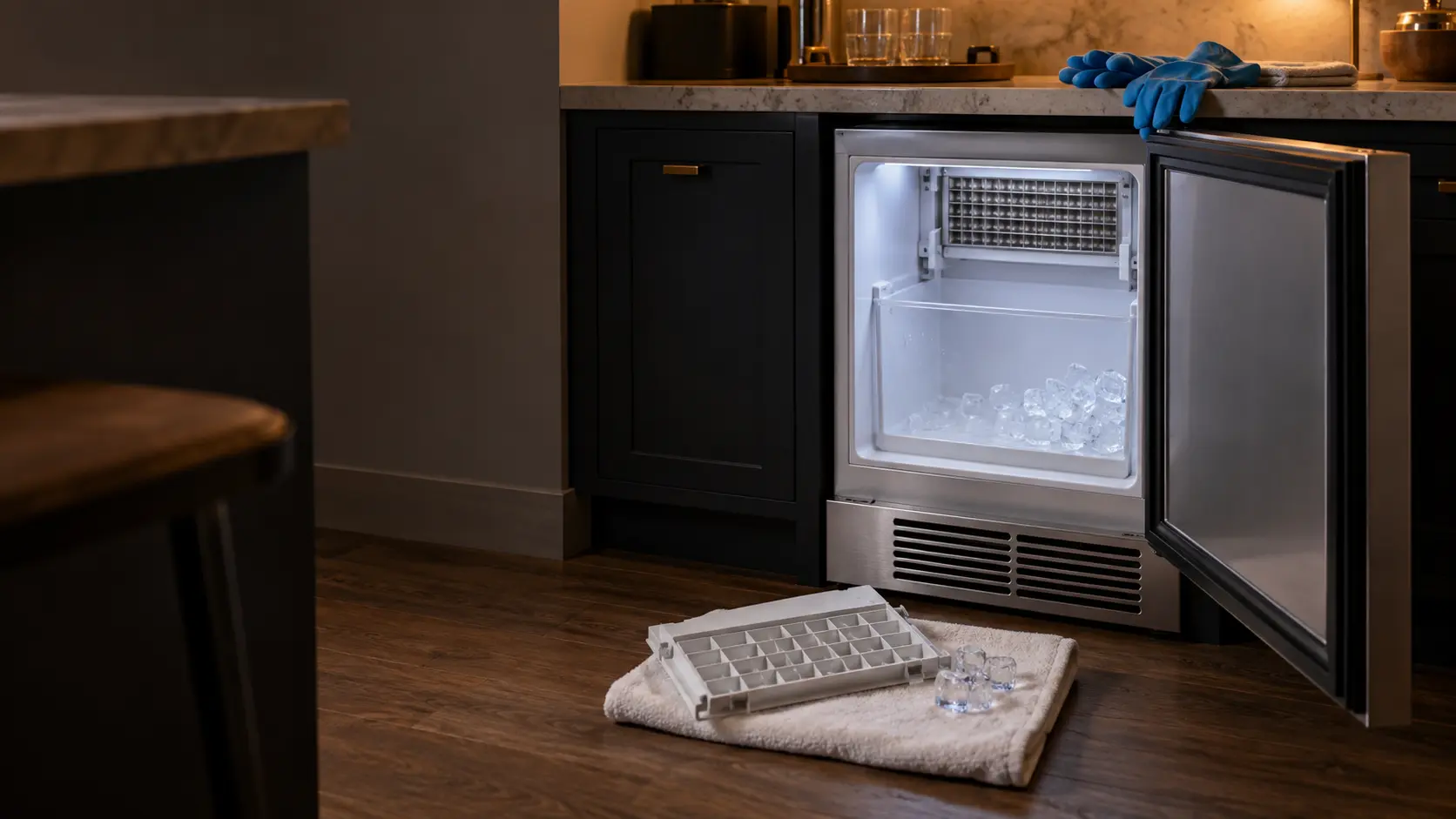
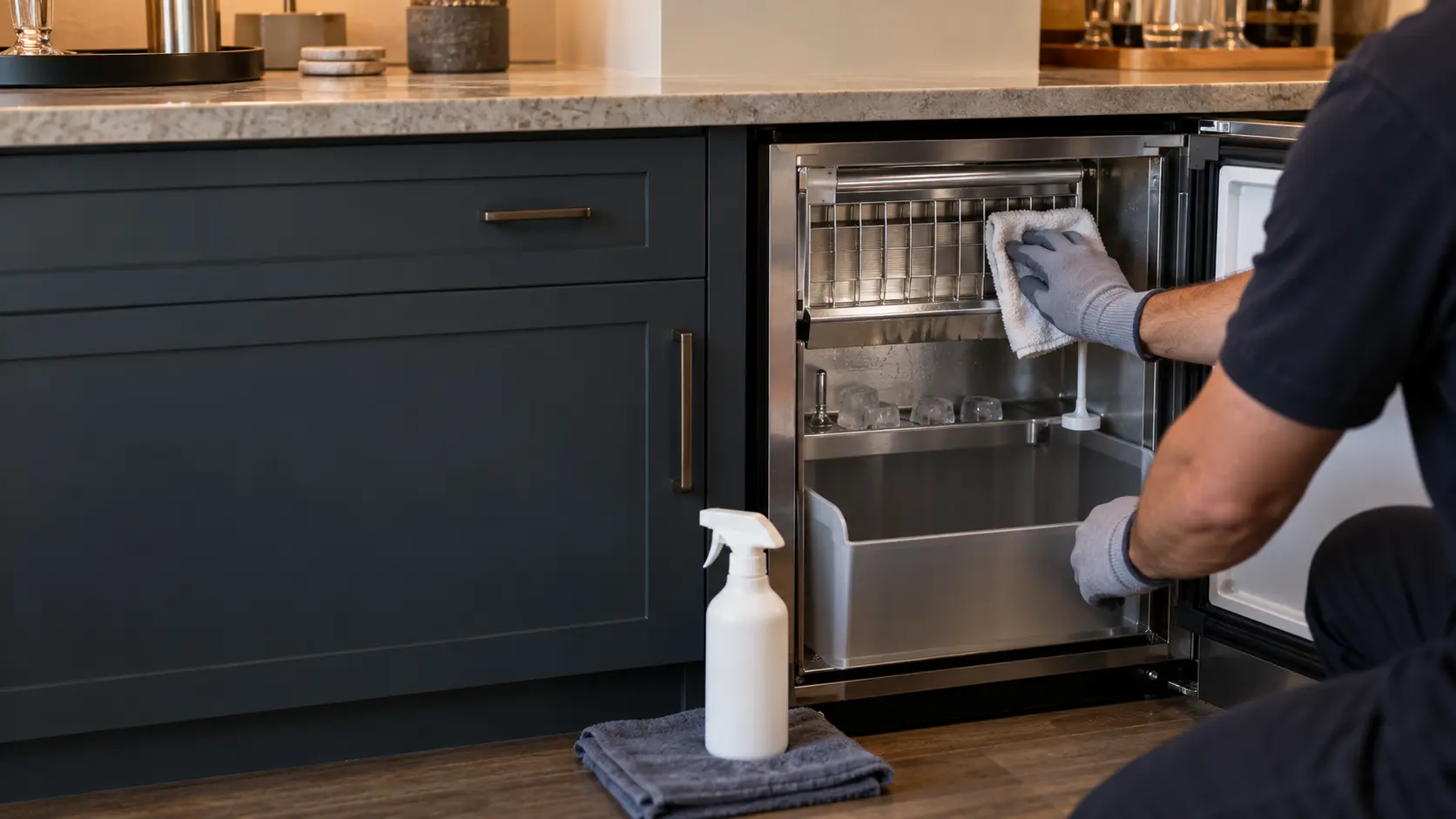
Most undercounter clear-ice units have a clean mode that circulates cleaner over the evaporator and sends it down the drain. U-Line's guide shows the sequence well: switch the unit off and let ice on the plate melt free, empty the bin, lift out the standpipe so the trough drains, wipe the bin and tubing with diluted cleaner, then start clean mode and pour cleaner into the trough once water is flowing over the plate. Its cycle takes about 45 minutes.
Use only the cleaner the manufacturer names. U-Line says any other product can ruin the finish of the evaporator, so a general household descaler is not a substitute, and it asks for rubber gloves and eye protection while the cleaner is being handled.
If the power drops mid-cycle
U-Line notes that a clean cycle interrupted by a power loss has to be run again from the beginning once power returns. Resist switching straight back to ice making, since cleaner may still be sitting in the trough.
Source: U-Line — Clear ice maker user guide and service manual (U-CLR1215B) — Clean at the alert or every three months with U-Line cleaner only; cycle about 45 minutes; repeat if power is lost; 1 tablespoon bleach per gallon for the storage area; discard the first harvest; uneven flow for up to 24 hours; condenser every six months with no cleaner; refresh kit for heavy lime scale; test water if cleaning is needed more often

Sanitizing the bin and throwing out the first harvest
Descaling an undercounter ice maker removes minerals; it does not sanitize. After the automatic cycle, U-Line calls for 1 tablespoon of household bleach in 1 gallon of warm water, wiped over the entire storage area and then rinsed off thoroughly with clean water.
The first ice after cleaning goes in the sink. U-Line asks owners to discard the whole first harvest on its clear-ice units and the first 10 minutes of production on its nugget units. It also warns that the water flow over the plate can be uneven for a while, so odd-sized cubes or a little water in the bin during the first 24 hours are expected.
Source: U-Line — Clear ice maker user guide and service manual (U-CLR1215B) — Clean at the alert or every three months with U-Line cleaner only; cycle about 45 minutes; repeat if power is lost; 1 tablespoon bleach per gallon for the storage area; discard the first harvest; uneven flow for up to 24 hours; condenser every six months with no cleaner; refresh kit for heavy lime scale; test water if cleaning is needed more often; U-Line — Maintaining your ice machine — Discard the first harvest after cleaning a clear-ice unit and the first 10 minutes of production on a nugget unit
The condenser and the front grille
An undercounter unit breathes through the grille at its base, and dust and lint on the condenser make it run longer to freeze every batch. U-Line sets a six-month interval: disconnect the power, remove the grille and clean the coil with a soft brush, a vacuum or compressed air, with no cleaner of any kind on it.
The fins are sharp, and U-Line says so in capital letters. Brush along them rather than across, keep fingers clear of the edges, and expect to clean more often in a home with shedding pets or a carpeted room next to the bar.
- Every clean cycle: bin, scoop, door gasket and the drain standpipe.
- Every six months: condenser coil and front grille.
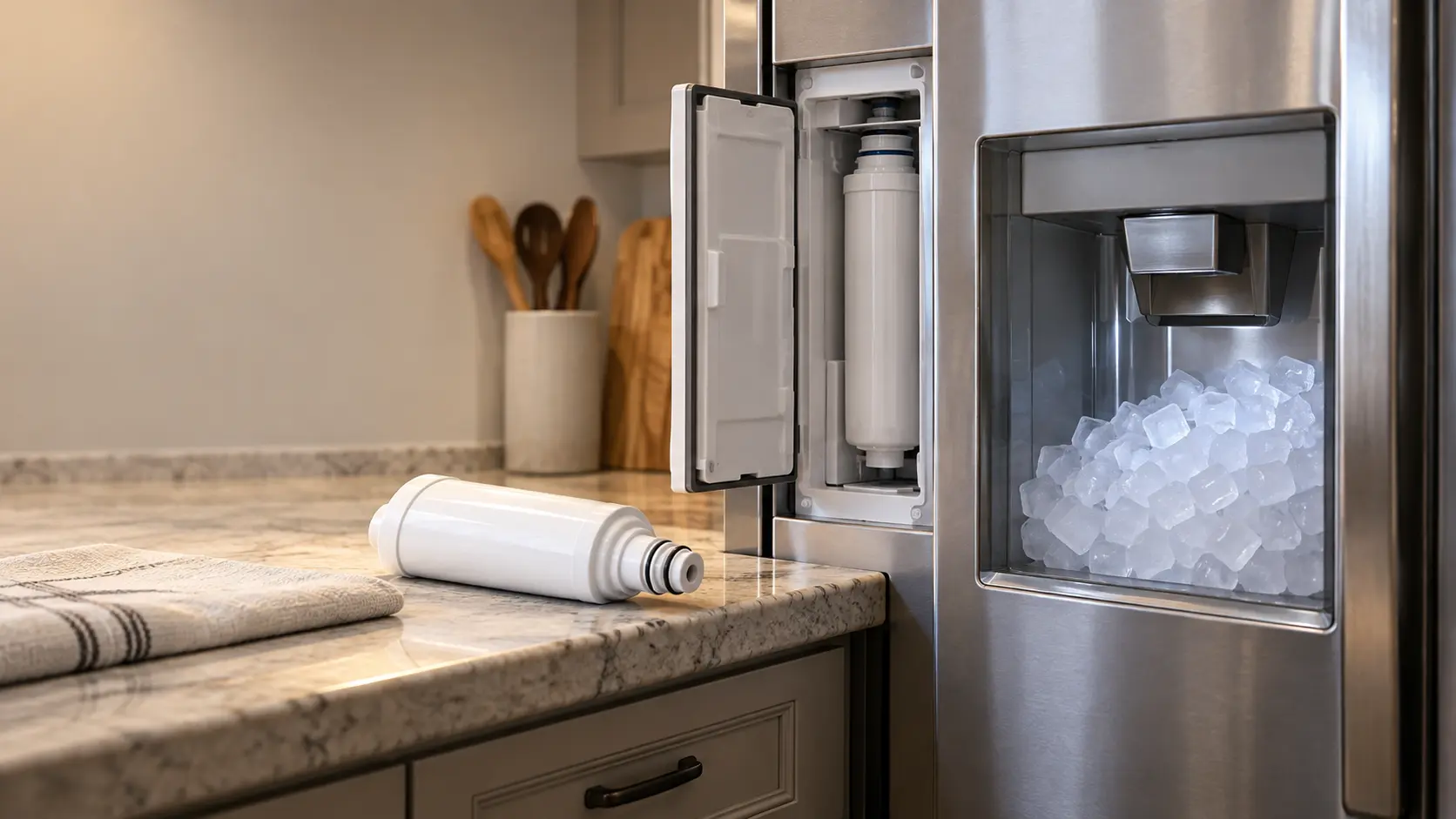
- On the cartridge's own schedule: the inline filter on the supply line, if one is fitted.
- Once a year: a look along the drain line and, on pump units, inside the pump reservoir.
Source: U-Line — Clear ice maker user guide and service manual (U-CLR1215B) — Clean at the alert or every three months with U-Line cleaner only; cycle about 45 minutes; repeat if power is lost; 1 tablespoon bleach per gallon for the storage area; discard the first harvest; uneven flow for up to 24 hours; condenser every six months with no cleaner; refresh kit for heavy lime scale; test water if cleaning is needed more often
When a clean cycle is not enough
A unit that has gone years without a clean cycle may be coated more deeply than one cycle can reach. A second cycle may loosen what the first left; when it does not, the scaled parts need replacing. U-Line offers a refresh kit that swaps many interior components on units heavily coated in lime scale, installed by a service company.
If the clean alert returns much sooner than three months, U-Line suggests having a plumber test the water and recommend treatment. A softener or a scale-reducing cartridge on the supply line is usually cheaper over the life of the unit than repeated evaporator and pump repairs.
Source: U-Line — Clear ice maker user guide and service manual (U-CLR1215B) — Clean at the alert or every three months with U-Line cleaner only; cycle about 45 minutes; repeat if power is lost; 1 tablespoon bleach per gallon for the storage area; discard the first harvest; uneven flow for up to 24 hours; condenser every six months with no cleaner; refresh kit for heavy lime scale; test water if cleaning is needed more often