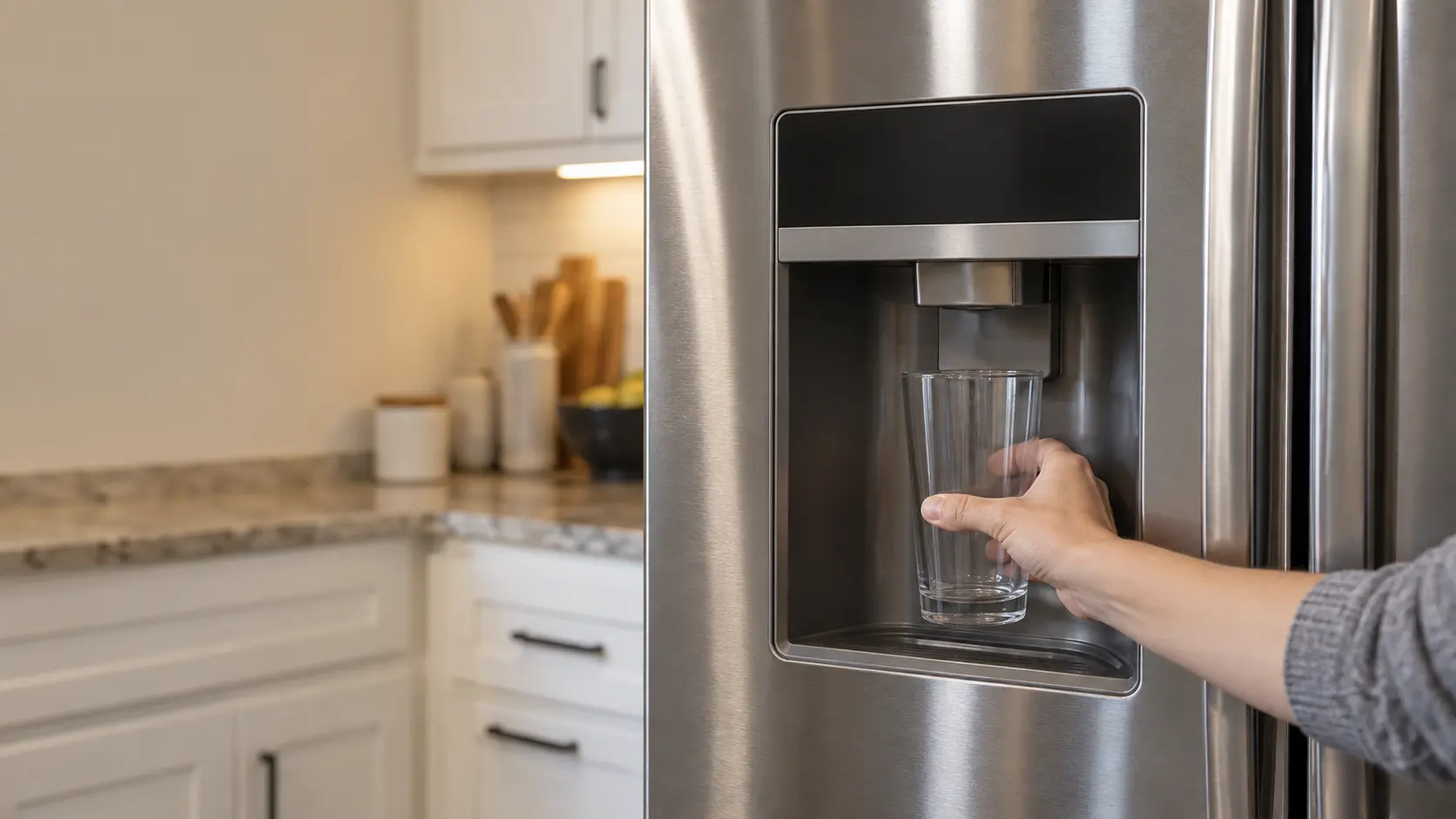
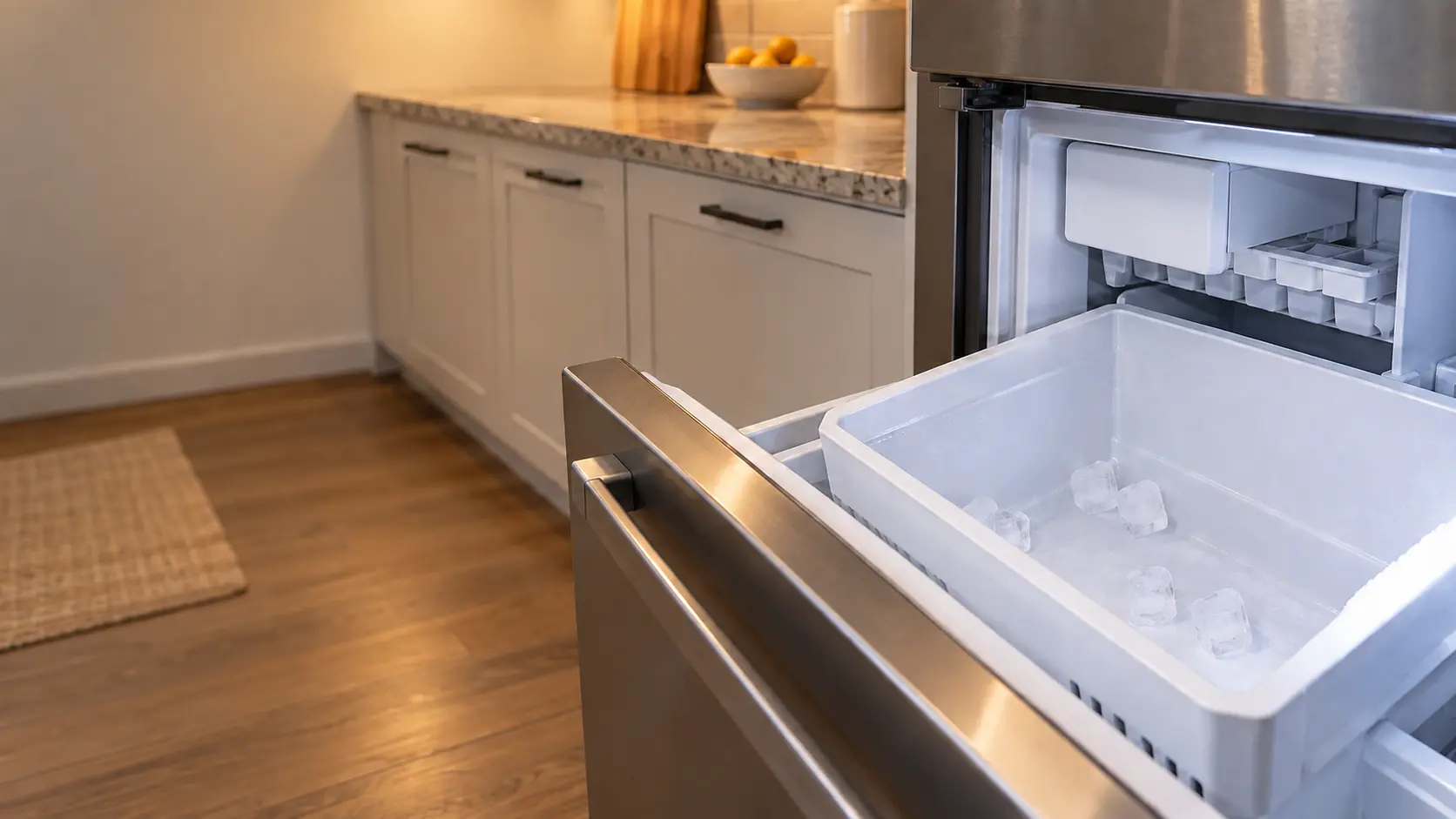
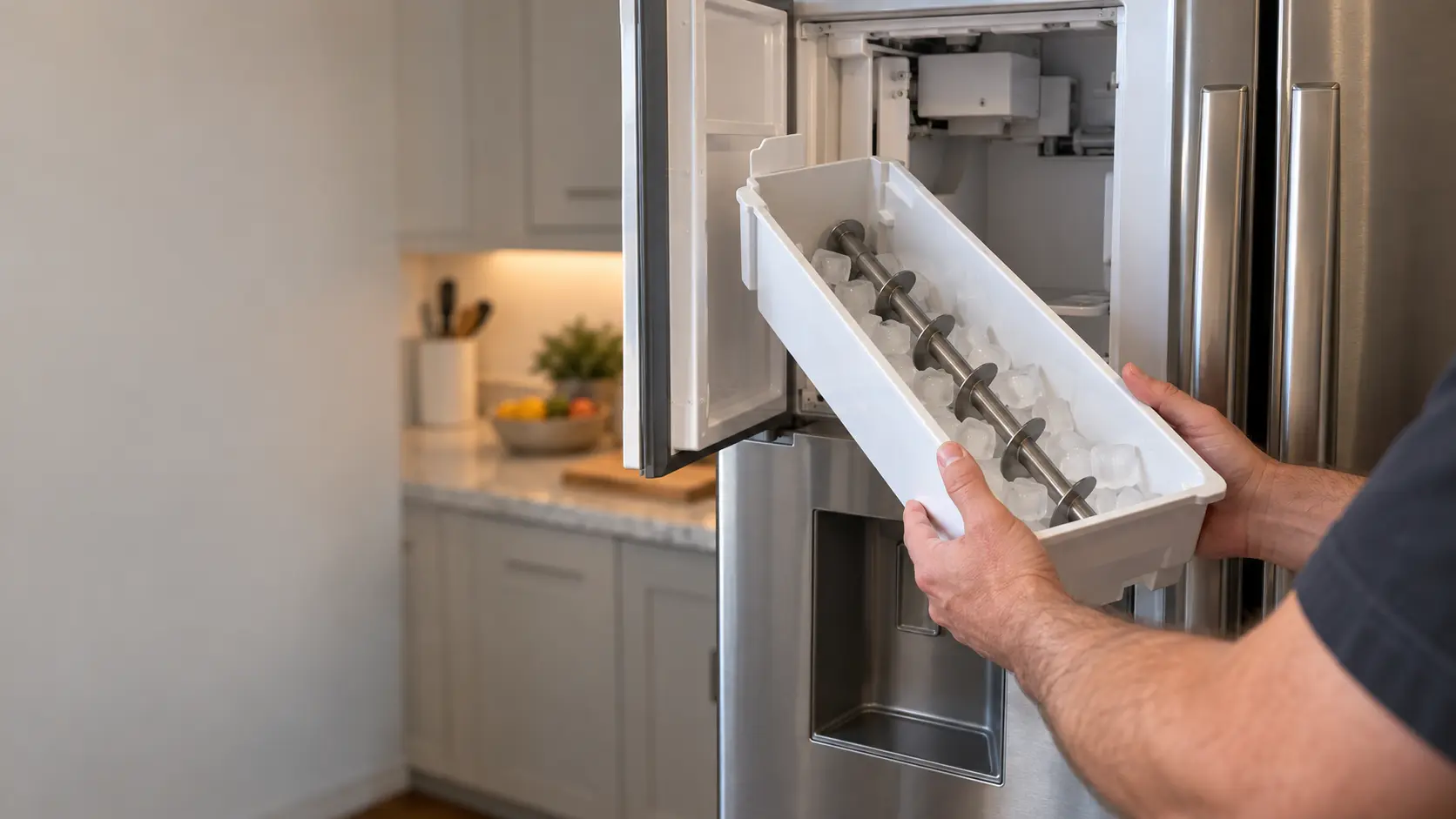
First, is there ice behind the dispenser?
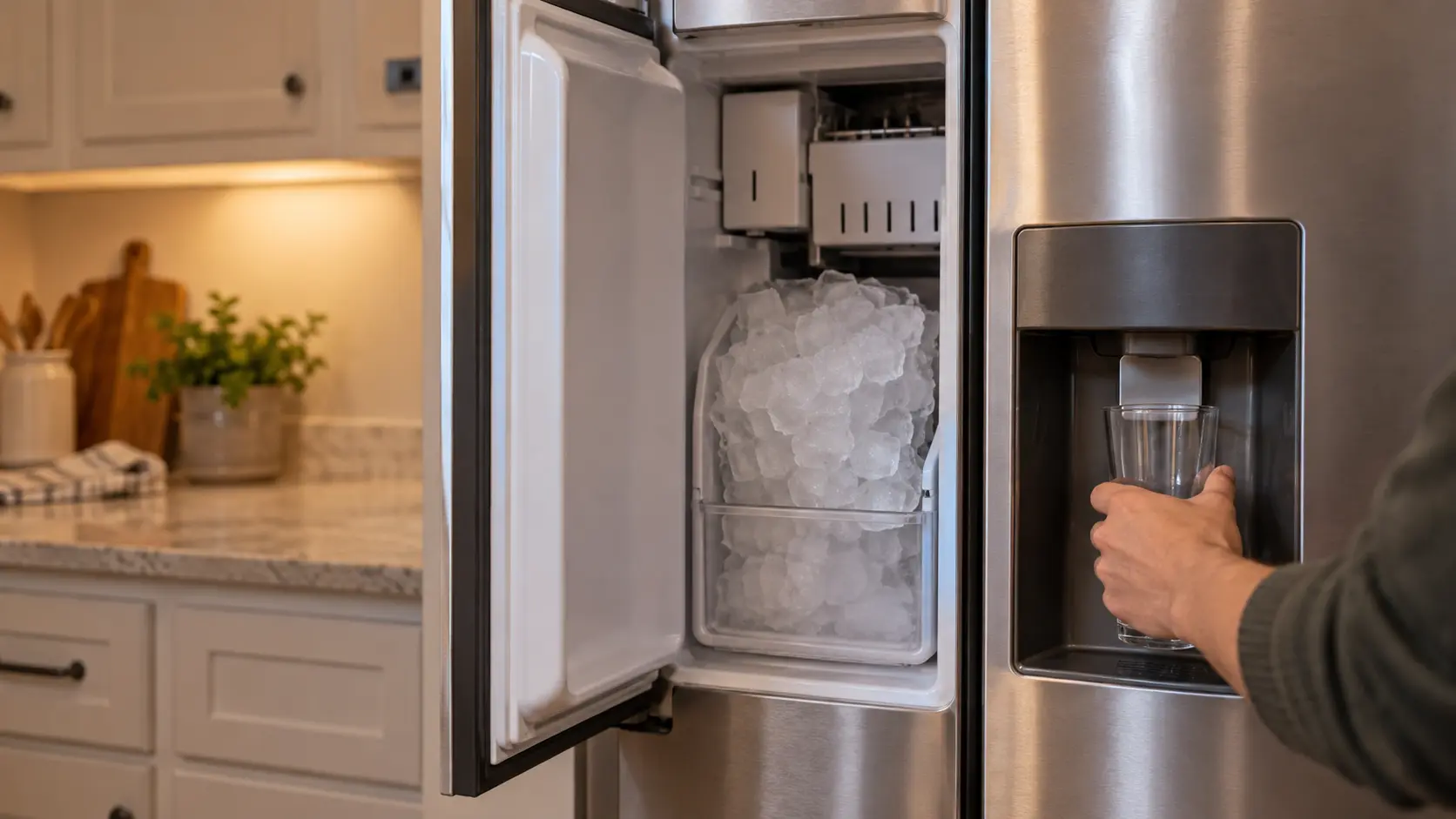
When the dispenser won't give ice, open the door and look at the bin before anything else. Samsung separates the two complaints for a reason: if the bin is empty, the problem is ice production and the fixes are about temperature and water; if the bin is full, the ice maker is doing its job and something between the bin and the glass is stopping delivery.
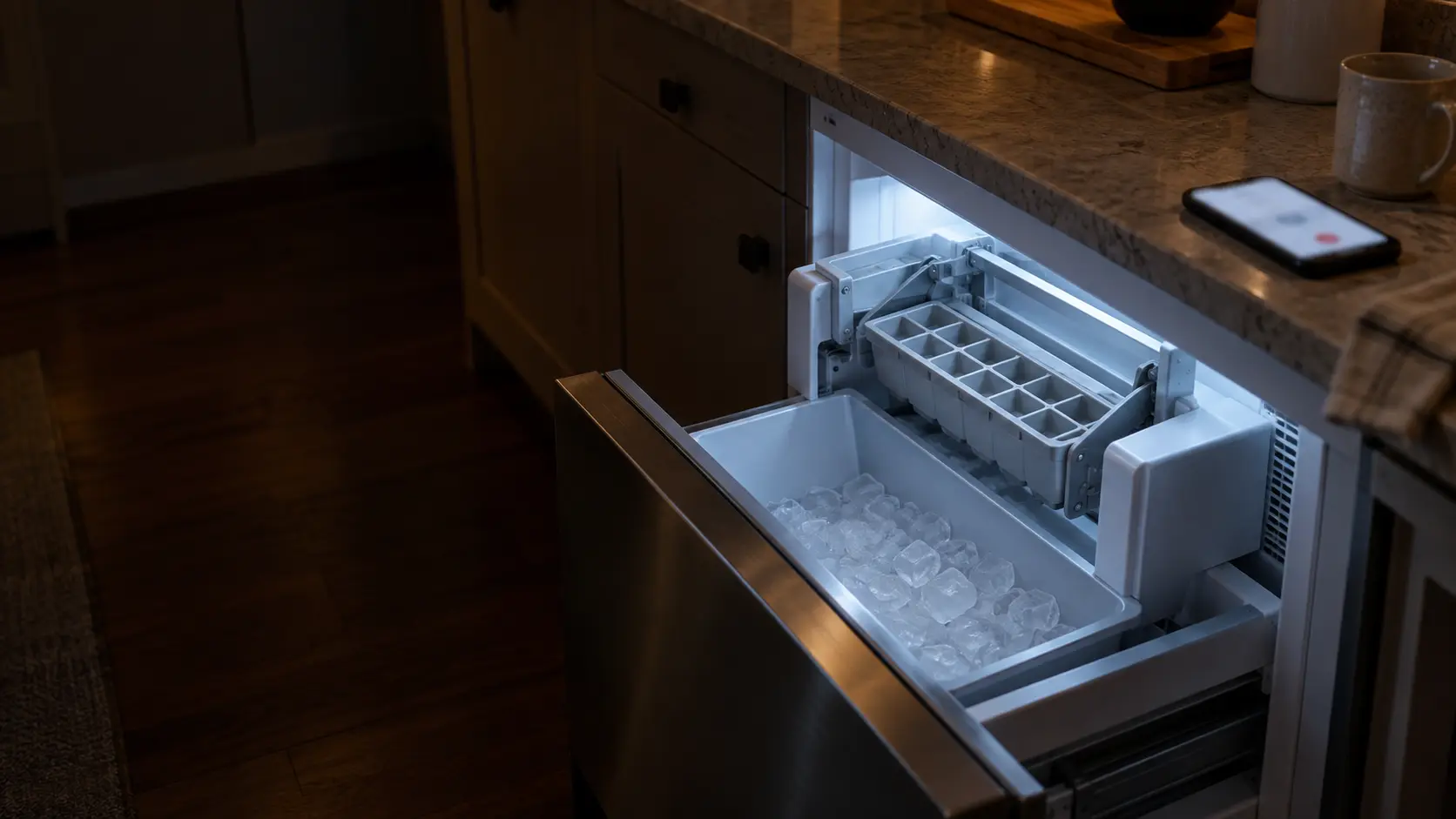
Where the bin sits depends on the layout. On a French door model it is usually a covered box high on the left fresh-food door or on the ceiling of the fresh-food side. On a side-by-side it is at the top of the freezer door. A few bottom-freezer models have a door dispenser fed from the fresh-food side as well. In every case the bin has an auger or a helix in its floor that pushes ice toward an opening, and that opening leads into the chute that ends above your glass.
Source: Samsung — Ice maker is not working — Dispenser and ice maker troubleshooting differ; dump ice every other week; a white wire hanging over a block of ice means service; do not force a frozen bucket or use a hair dryer
Settings and switches that block it on purpose
Dispensers are designed to lock, mainly so small children and pets cannot run ice onto the floor, and those locks are easy to turn on by accident. A few settings disable the dispenser along with the lights and the display. Check all of them before you open anything up, because each takes seconds.
- Control lock: a padlock or lock icon on the panel; Frigidaire's is released by holding the lock key for 3 seconds.
- Sabbath mode: Whirlpool notes it disables the dispenser and is usually toggled by holding its button for 3 seconds.
- Doors not fully closed: GE and Frigidaire both say the dispenser will not run with a door ajar.
- A light touch on the paddle: Whirlpool advises pressing a sturdy glass firmly against it so the switch closes fully.
- The run limit: Frigidaire's dispenser stops after 3 minutes of continuous use and works again once released.
Source: Frigidaire — Dispenser not dispensing ice — Hold the lock key 3 seconds to unlock; doors must be closed; the dispenser shuts off after 3 minutes of continuous use; turn a rotated auger in 45-degree steps; Whirlpool — Not dispensing ice — Sabbath mode held 3 seconds; press a sturdy glass firmly on the paddle; break clumps with a plastic utensil; clean the chute every 2 weeks if ice is not used regularly; GE Appliances — Not dispensing ice — Doors fully closed; frozen ice in the bucket gives crushed only or none, service if it returns; push a chute jam out with a wooden spoon; hold the cradle 30–60 seconds on cubed, service if nothing after 1 minute

Ice that has fused inside the bin
Cubes that sit unused slowly bond together as the surface of each one melts a little and refreezes, helped along by humidity every time the door opens. The auger can move loose cubes but not a solid block, so the dispenser runs, hums and delivers nothing.
Clumps in a household that rarely takes ice
This is the most common cause in homes where the dispenser is used a few times a week. Whirlpool suggests emptying the bin and wiping the chute every two weeks if ice is not taken regularly, and Samsung suggests dumping the bin every other week. A vacation home or a second kitchen gets clumps almost every time.
A solid block that keeps coming back
GE notes that frozen ice in the bucket can leave you with crushed ice only, or none, and says that if the block comes back after the bucket has been rinsed, the unit needs service. A block that reforms within days usually means water is getting into the bin: warm air through a bad seal or a flap that does not close, or a drip from the ice maker above. Samsung adds one sign to look for: a white wire hanging down from a freezer ice maker over a block of ice means service is needed.
Breaking it up without breaking the bin
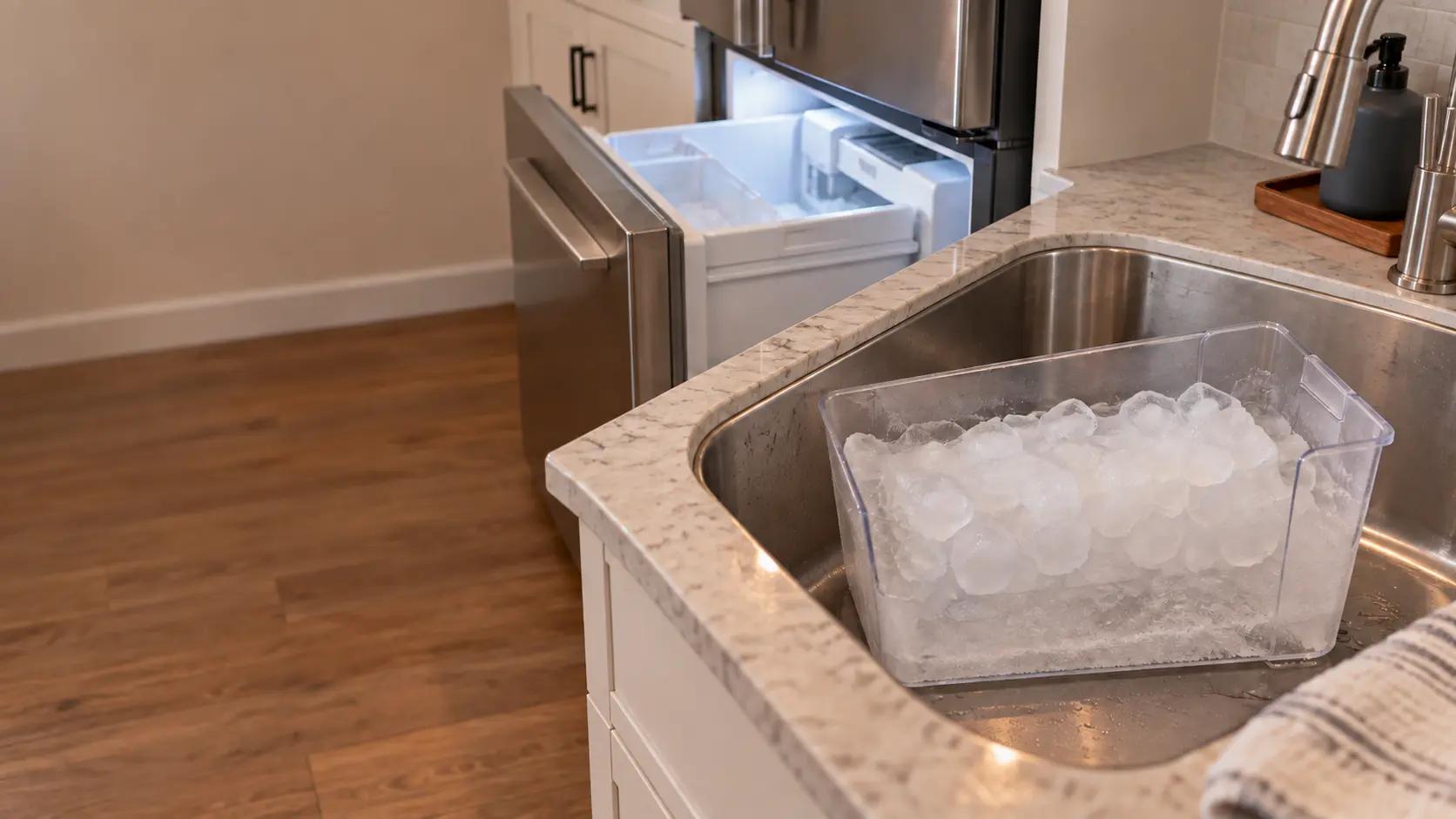
Lift the bin out, as the manual describes, and never pry it out if it is frozen in place. Loosen clumps with a plastic or wooden utensil, or run warm tap water over the bin in the sink until the block lets go, then dry it completely before putting it back. A wet bin freezes straight back into a block.
- Plastic or wooden spoon: yes.
- Warm tap water in the sink, bin out of the unit: yes.
- Knife, screwdriver or ice pick: no; the bin and auger are plastic.
- Hair dryer or heat gun aimed into the compartment: no; Samsung warns it damages the unit.
The chute and the flap in the door
Ice that leaves the bin falls through a short chute to the outlet above your glass. A cube or a shard can wedge there, and GE's advice is to push it out with a wooden spoon into a container. Wipe the chute afterward with a warm, damp cloth, since the meltwater left inside freezes into a ridge that catches the next cube.
At the top of the chute sits a flap that swings open while ice falls and closes behind it to keep warm air out. Samsung points out that a flap held open by ice or debris lets warm air into the ice compartment and frosts everything inside. A flap frozen shut does the opposite: the motor runs, the ice arrives and nothing comes out. When the flap has frozen more than once, the flap heater or seal needs a technician to look at it.
Source: GE Appliances — Not dispensing ice — Doors fully closed; frozen ice in the bucket gives crushed only or none, service if it returns; push a chute jam out with a wooden spoon; hold the cradle 30–60 seconds on cubed, service if nothing after 1 minute; Samsung — Frost forms in the freezer, refrigerator or ice bucket — A dispenser flap blocked by ice or debris lets warm air in and causes frost; do not use a hair dryer to speed defrosting
The auger, the helix and the motor behind them
The bin clips onto a drive coupling at the back of the compartment. If the auger inside the bin was turned while the bin was out, the coupling no longer lines up and the bin either will not seat or seats without engaging. Frigidaire's fix is to turn the auger in 45-degree steps until the bin fits; Samsung's is to turn the helix 90 degrees and try again until the bin clicks in.
GE describes one more case: moisture freezing on the auger motor behind the freezer wall. Its suggestion is to select cubed ice and hold a glass against the cradle for 30 to 60 seconds so the running motor warms itself, and it says that if no ice comes out after a minute, service is needed. Cubed ice working while crushed does not, or the reverse, points to the crusher blades or the gate that selects between them, and that is a repair for a technician.
Source: Frigidaire — Dispenser not dispensing ice — Hold the lock key 3 seconds to unlock; doors must be closed; the dispenser shuts off after 3 minutes of continuous use; turn a rotated auger in 45-degree steps; GE Appliances — Not dispensing ice — Doors fully closed; frozen ice in the bucket gives crushed only or none, service if it returns; push a chute jam out with a wooden spoon; hold the cradle 30–60 seconds on cubed, service if nothing after 1 minute; Samsung — Reset the ice maker in the fridge compartment or side-by-side freezer — If the bucket will not click into place, turn the helix 90 degrees and try again